Where does the AI dividend go?
What's the latest?
On Tuesday's Q2 earnings call, Jamie Dimon put numbers on what AI is doing inside JPMorgan: close to a thousand use cases in production, and "discrete areas where we did reduce jobs by 30% or 40%", with most of those people redeployed into other roles.
Then he told investors to be careful what they bank: "You don't uniquely benefit from AI. In a competitive, capitalist world, we all will use AI to do a better job for the customers."
A question came to mind: if the work is changing that much, and the margin is barely moving, where is all that value going?
Why does it matter?
It matters because the answer decides how you should write the business case. The dividend goes to three places. Your customers take the largest share, because every competitor has the same tools and the gain gets competed into price and service. The operating model takes the next share, the redesigned roles, the redeployed people, the new work. The margin gets what is left, and it is the smallest of the three.
So when the next initiative arrives with a savings line, ask:
- How much of the modelled saving survives competition, honestly?
- Where do the released hours go, and has the redeployment been costed?
- Who owns the workflow after the change, and who signs for the residual?
- If the margin case is thin, is the real case customer value, and does the board know that is what it is buying?
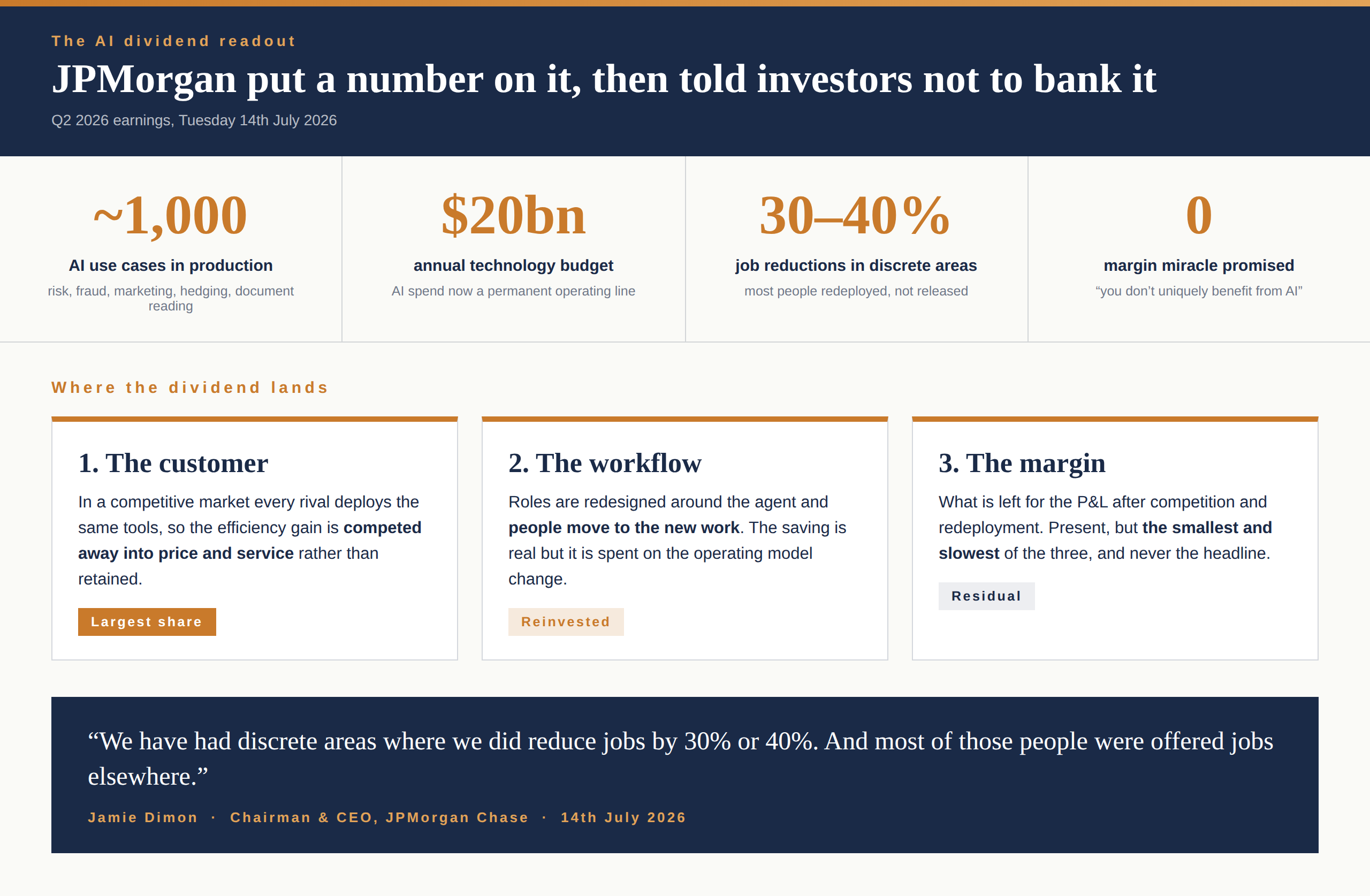
The AI dividend readout from JPMorgan's Q2. The saving is real, the question is where it lands.
My reframe question
Before you approve an AI business case on a savings line, can you show how much of that saving reaches the P&L after competition takes its share and the redeployment is paid for, and who signed for that number?
Every AI business case I read ends the same way, a savings line that lands neatly in next year's P&L. I see executive teams approve these numbers without asking the one question that matters: who actually keeps the saving?
This week the biggest bank in the world answered it, and the answer was mostly not us.